
 EN
EN
 English
 Client
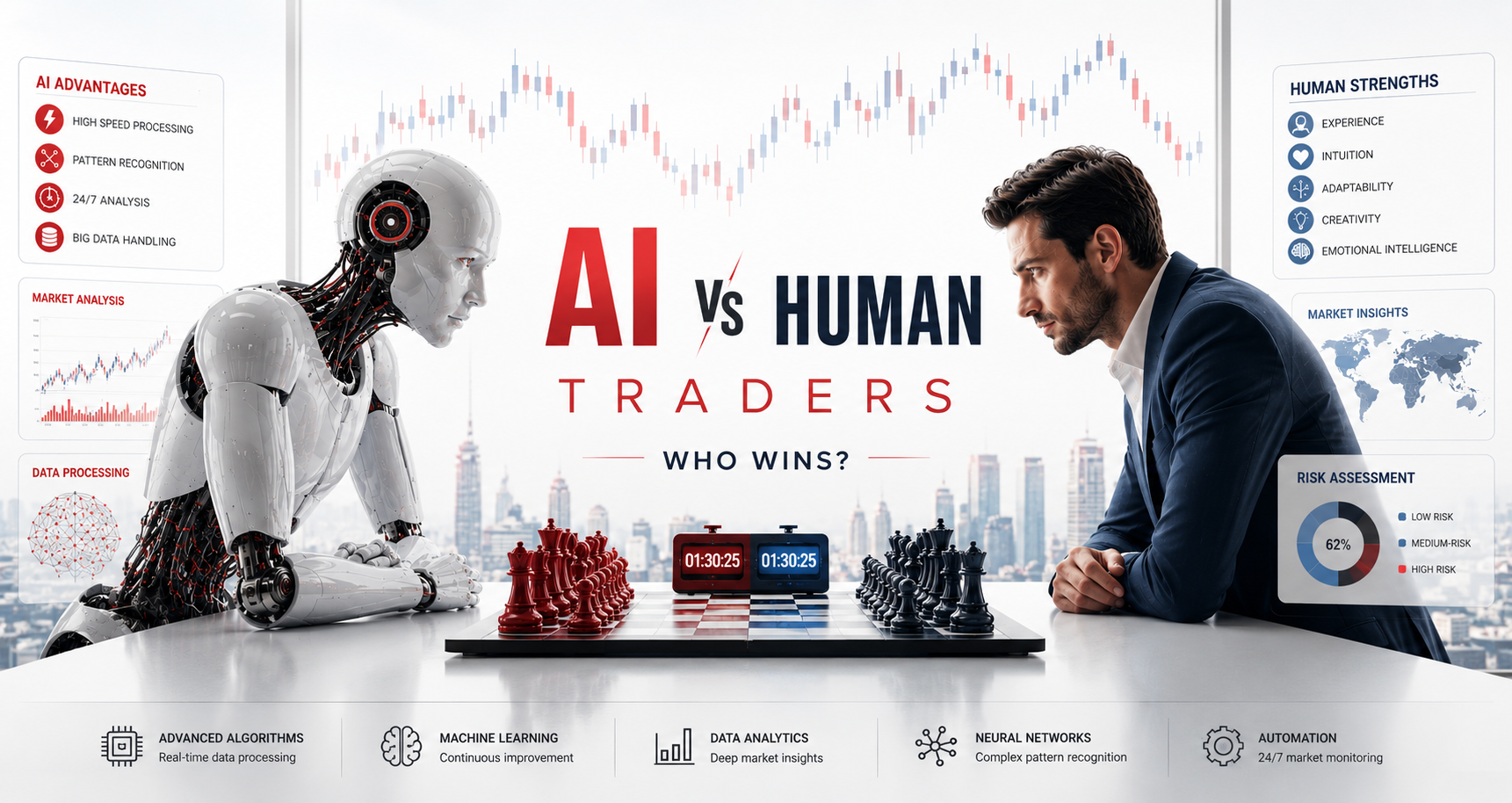
AI vs Human Traders - Who Really Wins in 2026?
The financial markets are changing rapidly. Artificial Intelligence is no longer just a futuristic concept - it is already being used by hedge funds, banks, institutional investors, and retail traders around the world.
From forex trading and gold analysis to cryptocurrency and stock markets, AI-powered trading systems are becoming more advanced every year.
But despite all this technology, one question still dominates the trading industry:
Can AI truly outperform human traders?
The answer is more complex than many people think.
While AI offers incredible speed, automation, and data analysis capabilities, human traders still maintain advantages in psychology, adaptability, and strategic thinking.
In reality, the future of trading may not be AI versus humans - but AI working alongside humans.
What Is AI Trading?
AI trading refers to the use of Artificial Intelligence, machine learning, and algorithmic systems to analyze financial markets and execute trading decisions.
Modern AI trading systems can:
- Scan thousands of market conditions instantly
- Analyze forex, stocks, crypto, and commodities simultaneously
- Detect hidden price patterns
- Generate trading signals
- Automate trade execution
- Manage risk dynamically
Today, many institutional firms use AI trading software to improve efficiency and reduce emotional decision-making.
According to Investopedia, AI-driven trading has become a major part of algorithmic market infrastructure worldwide.
Why AI Trading Is Growing So Fast
The popularity of AI trading continues to rise because financial markets now move faster than ever.
AI systems can process:
- Economic news releases
- Central bank decisions
- Market sentiment
- Price action
- Technical indicators
- Volatility patterns
- Correlation analysis
This gives AI a major advantage in speed and scalability.
For example, an AI trading bot can monitor multiple forex pairs like:
- EUR/USD
- GBP/USD
- USD/JPY
- XAU/USD (Gold)
…all at the same time without fatigue.
Human traders simply cannot process information at this scale continuously.
Advantages of AI Trading
1. Emotion-Free Decision Making
One of the biggest reasons traders fail is emotional trading.
Fear, greed, revenge trading, panic, and overconfidence often destroy consistency.
AI systems do not feel emotions.
They follow predefined logic and risk-management rules with discipline.
This makes AI particularly powerful in highly volatile markets like:
- Forex trading
- Gold trading
- Cryptocurrency trading
2. Faster Market Analysis
AI trading systems can analyze millions of market data points within seconds.
This includes:
- Candlestick patterns
- Market momentum
- Support and resistance zones
- Liquidity movements
- Volume analysis
- Historical probabilities
This speed is especially useful during high-impact economic events such as:
- CPI data
- Non-Farm Payrolls (NFP)
- Federal Reserve meetings
- Interest rate decisions
3. 24/7 Market Monitoring
Unlike humans, AI trading systems never sleep.
This is particularly valuable in:
- Cryptocurrency markets
- Asian forex sessions
- High-frequency trading environments
AI can continue monitoring opportunities even when traders are offline.
4. Advanced Backtesting
AI systems can test trading strategies across years of historical market data.
This helps traders:
- Optimize strategies
- Improve consistency
- Reduce unnecessary risk
- Identify weak trading setups
Professional trading firms heavily rely on this process.
Where Human Traders Still Win
Despite the rise of AI, human traders still hold several important advantages.
1. Understanding Market Psychology
Financial markets are driven by human emotion.
Fear and greed influence price action every single day.
Experienced traders can often sense:
- Market panic
- Irrational buying
- Sentiment shifts
- News manipulation
- Geopolitical uncertainty
AI systems struggle when markets behave irrationally outside historical patterns.
2. Adaptability During Unexpected Events
Humans can adapt quickly during:
- Economic crises
- Wars
- Political instability
- Flash crashes
- Black swan events
AI systems depend heavily on data patterns. When markets behave abnormally, many algorithms fail.
This is one reason why human oversight remains critical.
3. Strategic Thinking
Human traders can combine:
- Fundamental analysis
- Macroeconomic understanding
- Market sentiment
- Institutional behavior
- Long-term narratives
AI mainly focuses on probabilities and historical relationships.
Humans can understand context beyond raw numbers.
The Biggest Risk of AI Trading
One of the biggest misconceptions in the forex industry is that AI guarantees profits.
This is false.
Many low-quality platforms market “AI trading bots” with unrealistic promises.
Traders should remain cautious of:
- Guaranteed return claims
- Unrealistic win rates
- Fake AI platforms
- Poor risk management
- Overleveraged automation systems
The reality is:
No AI system can predict the market with 100% accuracy.
Even institutional algorithms experience losses.
The key difference is strong risk management and disciplined execution.
How Professional Traders Use AI
Most professional traders do not completely replace themselves with AI.
Instead, they use AI as an assistant.
AI helps with:
- Market scanning
- Data analysis
- Trade alerts
- Volatility detection
- Pattern recognition
- Risk calculations
Meanwhile, humans still make many strategic decisions.
This hybrid approach is becoming the dominant model in modern trading.
According to World Economic Forum, AI-driven financial technologies are expected to reshape global investing and trading infrastructure significantly over the next decade.
AI Trading in Forex Markets
Forex trading is one of the largest markets where AI is rapidly expanding.
AI forex systems are commonly used for:
- Scalping strategies
- Trend-following systems
- News trading
- High-frequency execution
- Correlation analysis
Popular forex-related searches include:
- Best forex broker
- AI forex trading software
- Forex trading strategies
- Best AI trading bot
- Gold trading signals
- XAU/USD analysis
This is why AI and forex remain one of the fastest-growing sectors in the financial industry.
So, Who Wins — AI or Human Traders?
The most realistic answer is:
Neither wins alone consistently.
The strongest results usually come from combining:
- AI speed and automation
- Human judgment and experience
AI is excellent for:
- Data analysis
- Automation
- Speed
- Pattern recognition
Humans are better at:
- Strategy
- Psychology
- Adaptability
- Risk interpretation
The future belongs to traders who can combine both effectively.
Final Thoughts
Artificial Intelligence is transforming the future of trading, but successful trading still requires:
- Discipline
- Risk management
- Patience
- Continuous learning
AI can improve efficiency dramatically, but it cannot fully replace human intelligence in complex financial markets.
The traders who succeed in 2026 and beyond will likely be those who learn how to use AI as a powerful trading tool - not as a shortcut to guaranteed profits.
Frequently Asked Questions (FAQ)
Is AI trading profitable?
AI trading can improve analysis and execution, but profitability depends on strategy quality, market conditions, and proper risk management.
Can AI predict forex markets?
AI can identify probabilities and patterns, but no trading system can predict markets with complete accuracy.
Do hedge funds use AI trading?
Yes. Many institutional firms and hedge funds use AI-powered algorithmic trading systems extensively.
Is AI trading safe for beginners?
AI trading still carries risks. Beginners should focus on education, demo trading, and understanding risk management before using automated systems.
What is the best AI trading software?
The best AI trading platforms depend on trading style, asset class, and risk tolerance. Traders should always research carefully before choosing any platform.
Explore Global Markets with Zed Capital
Recommended External Sources
- Investopedia - AI Trading Guide
- TradingView Market Analysis
- World Gold Council
- CoinMarketCap Crypto Market Data
⚠️ Educational purpose only.