
 EN
EN
 English
 Client
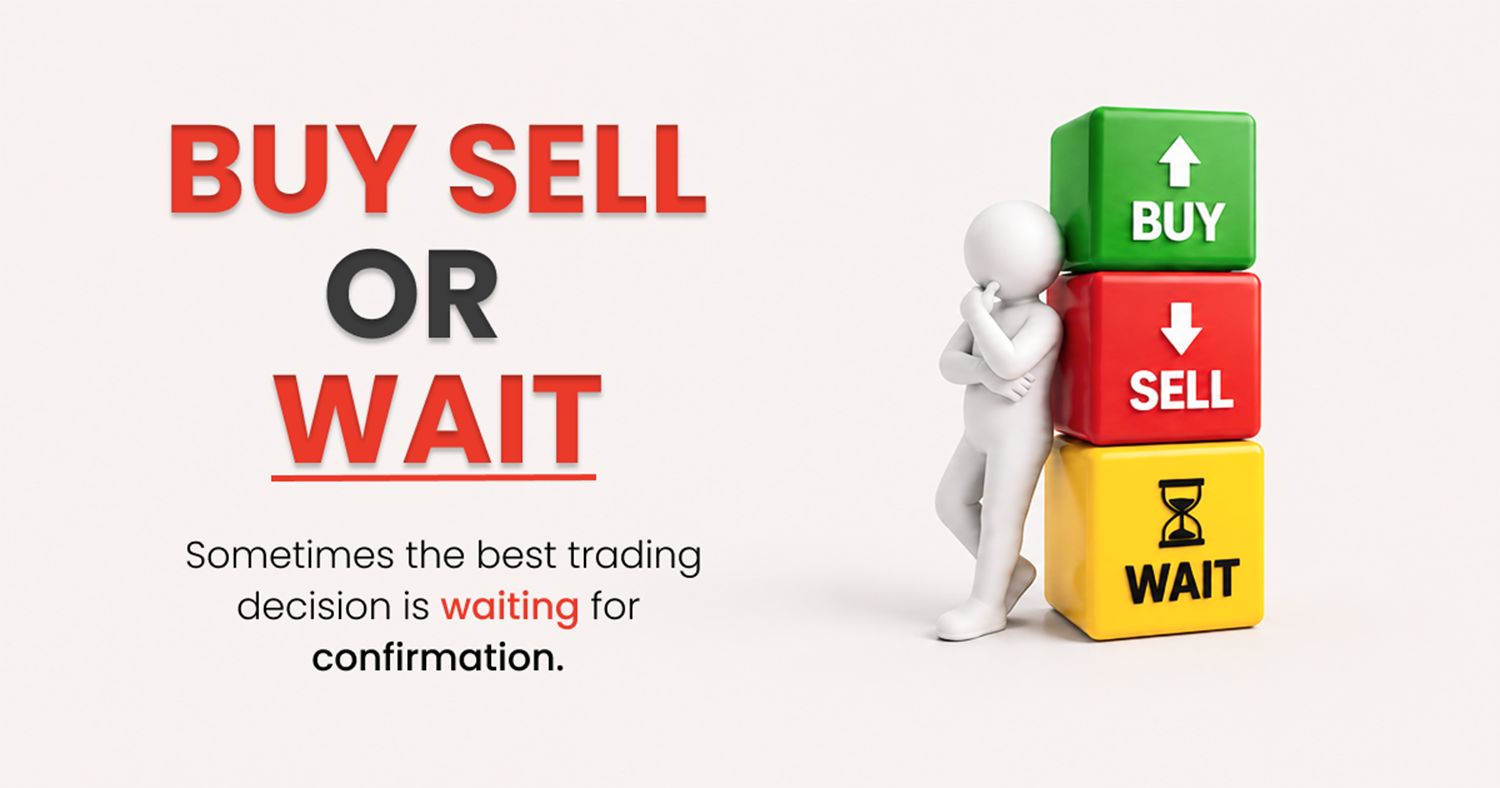
Buy, Sell or Wait? The Importance of Trading Confirmation
In financial markets, traders are often focused on two decisions: buy or sell.
However, there is a third decision that can be equally important:
Wait.
Not every market movement creates a suitable trading opportunity. In many situations, waiting for clearer trading confirmation can be more disciplined than entering a position simply because price is moving.
Professional trading is not about being active at all times. It is about evaluating market conditions, following a structured strategy and managing risk before committing capital.
What Is Trading Confirmation?
Trading confirmation refers to additional technical or fundamental evidence that supports a potential trade before an entry is made.
A trader may identify a possible opportunity, but instead of entering immediately, wait for the market to provide further evidence that supports the original analysis.
Depending on the strategy, confirmation may include:
Price reacting from a key support or resistance level
A breakout followed by a successful retest
A change in market structure
Bullish or bearish candlestick formations
Momentum confirmation
Trend alignment
Volume behaviour
Moving-average signals
Economic data
Major market or central-bank developments
No single confirmation method is suitable for every trader, and no signal can guarantee a profitable outcome.
The purpose of confirmation is to help create a more structured decision-making process.
Why Waiting Is Part of Professional Trading
One of the biggest misconceptions in trading is that being active means being productive.
It does not.
Markets can remain uncertain, volatile or directionless for long periods. During these conditions, opening a position simply to stay active can create unnecessary exposure.
Waiting allows traders to assess whether the market is actually offering a setup that fits their strategy.
A disciplined trader understands that:
No trade is also a position.
Choosing not to participate can be a deliberate risk-management decision when market conditions are unclear.
Buy: When Bullish Conditions Align
A buy opportunity may become more attractive when multiple bullish factors begin to align.
For example, a trader may observe price approaching an important support zone and then showing evidence that buyers are becoming active.
Potential bullish confirmation could include:
A strong reaction from support
A break above an important resistance level
A successful retest after a breakout
Higher highs and higher lows
Increasing bullish momentum
Confirmation from the broader market trend
The important point is that a trader is not buying simply because price has fallen or because the market appears cheap.
The decision is based on predefined conditions within the trading strategy.
Sell: When Bearish Conditions Are Confirmed
The same principle applies to sell positions.
A market moving higher does not automatically mean it is ready to reverse.
Professional analysis requires evidence.
Potential bearish confirmation may include:
Rejection from a major resistance area
A breakdown below support
Lower highs and lower lows
Weakening bullish momentum
Bearish market structure
A confirmed reversal pattern
Waiting for confirmation can help traders avoid entering a sell position while the underlying bullish trend remains strong.
Wait: When the Market Has Not Provided an Edge
Waiting can be the most appropriate decision when market conditions do not provide a clear trading advantage.
There are several situations where patience may be valuable.
Unclear Market Direction
If price is moving sideways between important levels, there may be no clear bullish or bearish structure.
Entering during this phase can result in repeated false signals.
Major Economic Events
Important announcements such as interest-rate decisions, inflation data, employment reports and central-bank statements can create sharp volatility.
Some traders prefer to wait until the initial market reaction becomes clearer.
Unconfirmed Breakouts
A short move above resistance or below support does not necessarily confirm a genuine breakout.
Price may return quickly inside the previous range.
Waiting for a close, retest or continuation signal can provide additional information.
Poor Risk-to-Reward Conditions
Even when market direction appears clear, a trade may not offer an attractive risk-to-reward profile.
If the stop loss required is too large relative to the potential target, waiting for a better entry may be more appropriate.
Emotional Pressure
If a trader feels pressured to enter because the market is moving quickly, the decision may be driven by emotion rather than analysis.
That is often a sign to reconsider the trade.
The Role of Patience in Trading
Patience is one of the most important elements of disciplined trading.
A trader can perform strong technical analysis and still make poor decisions by entering too early.
Waiting gives the market time to reveal more information.
It can help traders:
Reduce impulsive decisions
Avoid unnecessary market exposure
Stay aligned with a defined strategy
Improve entry quality
Evaluate risk more carefully
Maintain consistency
Patience does not mean waiting for a perfect setup.
Perfect setups do not exist.
It means waiting until the conditions required by the trading plan are present.
Avoiding FOMO
Fear of Missing Out, commonly known as FOMO, is a major psychological challenge in trading.
When a market begins moving rapidly, traders may believe they must enter immediately or lose the opportunity.
This can lead to:
Chasing price
Entering without confirmation
Ignoring stop-loss rules
Increasing position size
Taking trades outside the strategy
Making decisions based on emotion
A missed trade is not necessarily a loss.
There will always be another market session, another setup and another opportunity.
Professional trading requires the ability to accept that not every market move needs to be captured.
Confirmation Does Not Replace Risk Management
Even the strongest-looking setup can fail.
Trading confirmation can improve the structure of a decision, but it cannot remove market risk.
Every trade should therefore be supported by a clear risk-management framework.
This may include:
Defined entry levels
Stop-loss placement
Appropriate position sizing
Risk-to-reward assessment
Maximum risk per trade
Take-profit planning
Exit conditions
Before entering a position, a trader should know not only why the trade is being taken, but also how the position will be managed if the market moves in the opposite direction.
A Simple Buy, Sell or Wait Framework
A structured trading process can help reduce emotional decision-making.
Before taking a position, consider the following three questions.
1. What Is the Current Market Direction?
Identify whether the market is bullish, bearish or neutral.
This can be evaluated using market structure, trend behaviour and key technical levels.
2. Has the Setup Been Confirmed?
Determine whether the specific conditions required by the trading strategy have been met.
If the setup is incomplete, there may be no reason to enter yet.
3. Is the Risk Acceptable?
Evaluate the proposed entry, stop loss, target and position size.
A valid market idea can still be a poor trade if the risk is not suitable.
If any of these factors are unclear, waiting may be the better decision.
Why Discipline Matters More Than Constant Activity
The financial markets create opportunities every day, but not every opportunity is suitable for every trader.
Trading discipline means following a strategy even when emotions encourage a different action.
This includes the discipline to:
Enter when the setup is valid
Exit when the plan requires it
Respect risk limits
Accept losing trades
Avoid revenge trading
Stay out of the market when conditions are unclear
Long-term consistency depends less on predicting every market move and more on following a repeatable decision-making process.
Frequently Asked Questions
What is trading confirmation?
Trading confirmation is additional evidence that supports a potential trade before entry. It may come from price action, technical indicators, market structure, economic data or a combination of factors.
Is it better to wait before entering a trade?
Waiting can be appropriate when a setup has not yet met the conditions required by a trading strategy. However, the decision depends on the trader's methodology and market conditions.
What does buy, sell or wait mean in trading?
It refers to three possible trading decisions. A trader may buy when bullish conditions are confirmed, sell when bearish conditions are confirmed or wait when the market does not currently provide a suitable setup.
Why is patience important in forex trading?
Patience can help traders avoid emotional entries, wait for clearer confirmation and remain consistent with their trading strategy.
Does trading confirmation guarantee profit?
No. No trading strategy, indicator or confirmation technique can guarantee a profitable outcome. Risk remains present in every trade.
When should a trader stay out of the market?
A trader may choose to stay out when market direction is unclear, volatility is unusually high, risk-to-reward conditions are poor or the required trading confirmation has not developed.
Final Thoughts
The most important trading decision is not always whether to buy or sell.
Sometimes, it is knowing when to do neither.
Waiting for confirmation can help traders make decisions based on market structure, strategy and risk rather than emotion.
Before every trade, the key questions should be:
Is the market direction clear?
Has my setup been confirmed?
Is the risk acceptable?
If the answer is not clear, waiting can be a disciplined and professional decision.
At ZED Capital, we believe trading should be approached with preparation, structured analysis and responsible risk management.
Buy. Sell. Or Wait.
Sometimes, the strongest decision is simply waiting for confirmation.
Risk Warning
Trading leveraged financial products involves significant risk and may not be suitable for all investors. Past performance is not a reliable indicator of future results. Market conditions can change rapidly and losses may occur. Ensure that you fully understand the risks involved and consider your financial circumstances and risk tolerance before trading.