
 EN
EN
 English
 Client
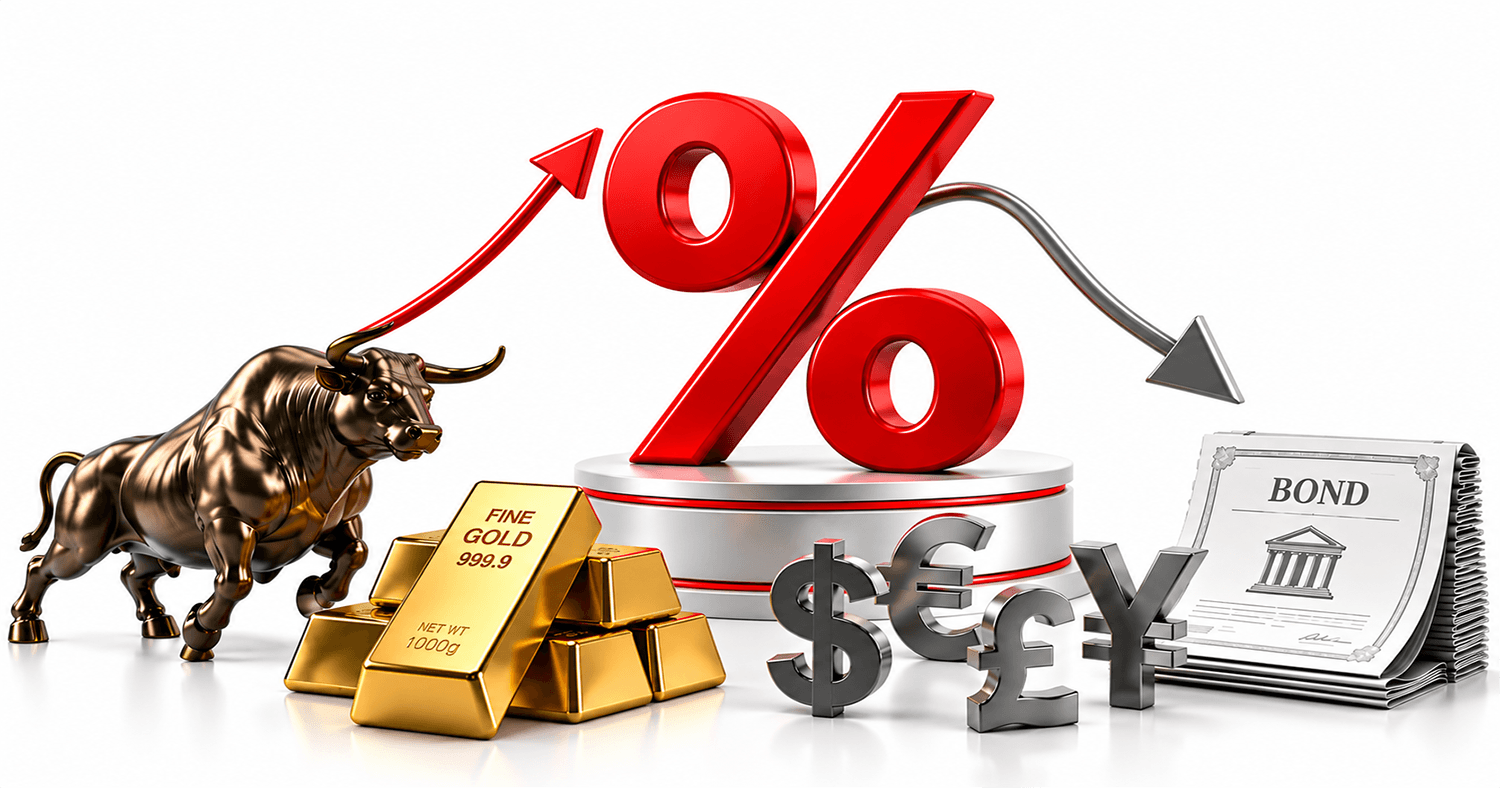
How Interest Rates Affect Stocks, Gold, Currencies and Bonds
Interest rates are among the most influential forces in global financial markets.
A single change in interest-rate expectations can affect stock valuations, bond yields, currencies, gold prices, borrowing costs and investor sentiment.
This is why investors closely monitor central banks such as the U.S. Federal Reserve, European Central Bank, Bank of England and Bank of Japan.
But interest rates do not affect every asset in the same way.
Higher rates may create pressure on certain stocks while supporting a currency. Bond prices can fall when yields rise, while gold may react to changes in real interest rates, inflation expectations and the U.S. dollar.
Understanding these relationships can help investors interpret financial markets more effectively.

Quick Answer: How Do Interest Rates Affect Financial Markets?
Interest rates affect financial markets by changing the cost of borrowing, the return available on cash and bonds, company financing costs and the relative attractiveness of different investments.
In general:
Higher interest rates can increase borrowing costs and reduce financial liquidity.
Lower interest rates can make borrowing cheaper and create more supportive financial conditions.
Stocks may react to changes in company financing costs and valuations.
Bond prices generally move inversely to interest rates.
Gold can be influenced by real yields and currency movements.
Currencies may strengthen when interest rates become relatively more attractive.
However, market reactions are never determined by interest rates alone.
Inflation, economic growth, investor expectations and central-bank guidance also matter.
What Are Interest Rates?
An interest rate represents the cost of borrowing money or the return earned for lending or holding certain interest-bearing assets.
Central banks influence short-term interest rates as part of monetary policy.
Their objectives commonly include maintaining price stability, supporting sustainable economic activity and promoting financial stability.
When inflation becomes too high, a central bank may increase interest rates.
When economic conditions weaken or inflation becomes less concerning, a central bank may consider reducing rates.
These decisions can influence the entire financial system.
Why Do Central Banks Change Interest Rates?
Central banks generally adjust monetary policy in response to changing economic conditions.
Several factors can influence their decisions.
These include:
Inflation
Employment
Economic growth
Consumer spending
Business activity
Financial conditions
Credit growth
Economic risks
If inflation remains persistently high, central banks may maintain higher interest rates to reduce demand and ease inflationary pressure.
If economic activity weakens significantly, lower interest rates may help make borrowing more affordable and support spending and investment.
This creates what is known as the monetary policy transmission mechanism.
A change in policy rates can gradually influence banks, companies, consumers, financial markets and eventually the broader economy.
What Happens When Interest Rates Rise?
When central banks increase interest rates, borrowing generally becomes more expensive.
Consumers may face higher costs for mortgages, loans and credit.
Businesses may also face higher financing costs.
This can affect:
Business investment
Consumer spending
Company valuations
Housing activity
Credit demand
Bond yields
Currency markets
Investor sentiment
Higher rates can also make interest-bearing investments more attractive relative to some riskier assets.
However, an interest-rate increase does not automatically mean financial markets will fall.
If investors already expected the increase, much of the impact may already be reflected in market prices.
What Happens When Interest Rates Fall?
Lower interest rates generally reduce borrowing costs.
This can make financing more affordable for businesses and consumers.
Lower rates may help support:
Business investment
Consumer spending
Credit demand
Economic activity
Market liquidity
Lower interest rates can also reduce the returns available on certain cash and fixed-income investments.
This may encourage some investors to consider other asset classes.
But lower interest rates are not always positive for markets.
If a central bank is cutting rates because the economy is deteriorating rapidly, investors may remain cautious despite easier monetary policy.
This is why understanding why rates are changing is essential.
How Interest Rates Affect Stocks
Interest rates can affect stocks through borrowing costs, corporate earnings expectations and valuations.
1. Company Borrowing Costs
Companies frequently borrow money to finance operations, expansion, acquisitions and investment.
When interest rates rise, borrowing becomes more expensive.
Companies with significant debt may experience higher financing costs.
This can potentially reduce the amount of cash available for expansion, investment or shareholder distributions.
When rates fall, financing conditions may become more favourable.
2. Stock Valuations
Interest rates are also important in company valuation.
Investors often estimate the present value of a company's expected future cash flows.
When interest rates and discount rates rise, the present value assigned to future cash flows may decline.
This can create valuation pressure, particularly for companies whose expected cash flows are concentrated further into the future.
Growth-oriented companies can therefore be particularly sensitive to large changes in interest-rate expectations.
3. Different Sectors Can React Differently
Not every stock market sector responds to interest rates in the same way.
Banks, technology companies, utilities, real estate businesses and consumer companies can each react differently depending on economic conditions.
For example, financial institutions may benefit from certain interest-rate environments, while highly leveraged businesses may face increased financing pressure.
Investors should therefore avoid assuming that one interest-rate decision will affect every stock equally.
Do Stocks Always Fall When Interest Rates Rise?
No.
Stocks do not automatically fall when interest rates rise.
The market reaction depends on several factors, including:
Why rates are rising
How quickly rates are changing
Inflation expectations
Economic growth
Corporate earnings
Whether the decision was already expected
Future central-bank guidance
If interest rates rise because the economy is performing strongly, some businesses may continue to experience healthy demand.
The relationship between stocks and interest rates should therefore be analysed within the wider economic environment.
How Interest Rates Affect Bonds
The relationship between interest rates and bonds is one of the most important concepts in fixed-income investing.
Bond prices and interest rates generally move in opposite directions.
When market interest rates rise, existing bonds offering lower fixed interest payments may become less attractive.
Their market prices can therefore decline.
When interest rates fall, existing bonds offering relatively higher fixed payments may become more attractive, potentially increasing their market value.
Simple Bond Example
Imagine an existing bond pays a fixed return based on conditions when it was issued.
If newly issued bonds begin offering substantially higher yields, investors may prefer the newer securities.
For the older bond to remain competitive, its market price may need to decline.
The opposite can happen when market rates fall.
This is why investors frequently hear:
When yields rise, bond prices generally fall.
When yields fall, bond prices generally rise.
What Is the Difference Between Interest Rates and Bond Yields?
Interest rates and bond yields are related but are not exactly the same thing.
A central bank sets or influences key policy interest rates.
Bond yields are determined in financial markets and reflect factors including:
Interest-rate expectations
Inflation expectations
Economic growth
Credit risk
Supply and demand
Investor sentiment
Government bond yields can therefore move before a central bank officially changes its policy rate.
This happens because markets constantly attempt to anticipate future monetary policy.
How Interest Rates Affect Gold
Gold reacts differently from stocks and bonds because gold does not pay traditional interest.
This means investors often compare the attractiveness of gold with interest-bearing assets.
When interest rates rise, assets such as government bonds or savings instruments may offer higher yields.
This can sometimes reduce the relative attractiveness of holding gold.
However, the relationship is more complex than simply:
Higher rates = lower gold
or
Lower rates = higher gold.
Several other factors matter.
Real Interest Rates Matter for Gold
Real interest rates are particularly important when analysing gold.
A simplified way to think about real interest rates is:
Real Interest Rate = Nominal Interest Rate − Inflation
If nominal interest rates increase while inflation falls, real yields may rise.
Higher real yields can increase the opportunity cost of holding a non-yielding asset such as gold.
If real yields fall, the relative opportunity cost of holding gold may decrease.
For this reason, professional market participants often monitor real yields alongside headline interest rates.
The U.S. Dollar and Gold
Interest rates can also affect gold indirectly through the U.S. dollar.
Gold is widely priced internationally in U.S. dollars.
If higher U.S. interest-rate expectations contribute to a stronger dollar, gold may become more expensive for buyers using other currencies.
This can influence demand.
However, gold is also affected by:
Inflation expectations
Geopolitical uncertainty
Central-bank demand
Investment flows
Real bond yields
Market risk sentiment
Interest rates should therefore be considered as one part of a broader gold analysis.
How Interest Rates Affect Currencies
Interest-rate differences between countries are a major influence on foreign exchange markets.
Investors often compare the potential return available from assets denominated in different currencies.
If one country offers higher interest rates than another, its currency may become relatively more attractive to some investors.
This can create international capital flows.
For example, if investors expect U.S. interest rates to remain higher relative to other major economies, demand for U.S. dollar-denominated assets may increase.
That can potentially support the U.S. dollar.
However, higher interest rates do not guarantee a stronger currency.
Why Can a Currency Fall Even When Interest Rates Rise?
Currency values depend on expectations.
Imagine a central bank raises rates by 0.25%, but investors expected a larger increase.
The currency could weaken because the decision was less aggressive than anticipated.
Currencies can also respond to:
Economic growth
Inflation
Government finances
Political risk
Trade balances
Central-bank guidance
Global investor sentiment
Future interest-rate expectations
This is why foreign exchange markets often react more strongly to the future interest-rate outlook than to the current rate itself.
Interest Rate Differentials and Forex Markets
An interest-rate differential is the difference between interest rates in two economies.
This concept is especially important in foreign exchange markets.
For example, investors analysing EUR/USD may compare monetary policy expectations for the European Central Bank and the U.S. Federal Reserve.
For GBP/USD, markets may compare the Bank of England with the Federal Reserve.
For USD/JPY, differences between U.S. and Japanese monetary conditions can be particularly important.
Changes in expected interest-rate differentials can influence currency trends even before central banks officially change policy.
Stocks vs Gold vs Currencies vs Bonds
The impact of interest rates can be summarised as follows:
| Asset | When Interest Rates Rise | When Interest Rates Fall |
| Stocks | Higher financing costs may pressure valuations | Lower financing costs may support valuations |
| Bonds | Existing bond prices generally face pressure | Existing bond prices may become more attractive |
| Gold | Higher real yields can create headwinds | Lower real yields can improve relative attractiveness |
| Currencies | Relatively higher rates may support a currency | Relatively lower rates may reduce currency attractiveness |
These are general relationships rather than guaranteed outcomes.
The reason for the rate change and overall economic conditions remain critical.
Why Market Expectations Matter More Than the Rate Decision Alone
Financial markets are forward-looking.
Investors constantly attempt to anticipate what central banks will do next.
As a result, market prices may change weeks or months before an official rate decision.
Suppose investors widely expect an interest-rate cut.
Stocks, bonds, gold and currencies may already begin adjusting before the central bank meeting.
If the expected cut then occurs, the immediate market reaction may be relatively small.
But if the central bank unexpectedly keeps rates unchanged, markets could react sharply.
This leads to an important principle:
Markets respond not only to what happens, but to how the outcome compares with expectations.
What Investors Should Watch Before a Central-Bank Decision
Investors analysing interest-rate expectations commonly monitor several economic indicators.
Inflation Data
Inflation indicators can provide information about price pressures within an economy.
Persistent inflation may encourage central banks to maintain restrictive monetary policy for longer.
Employment Data
Strong labour markets can support consumer spending but can also contribute to wage and inflation pressures.
Weak employment conditions may indicate slower economic activity.
GDP and Economic Growth
Economic growth data can help investors understand whether an economy is expanding or weakening.
Consumer Spending
Consumer spending is an important part of many major economies.
Changes in spending patterns can influence economic growth expectations.
Business Activity
Purchasing Managers' Indexes and other business surveys can provide information about manufacturing and service-sector conditions.
Central-Bank Communication
Comments from central-bank officials can significantly influence markets.
Investors monitor speeches, meeting statements and economic projections for clues about future policy.
Nominal Interest Rates vs Real Interest Rates
Understanding the difference between nominal and real interest rates can improve financial-market analysis.
The nominal interest rate is the stated rate.
The real interest rate takes inflation into account.
For example, an interest rate may appear high in nominal terms.
But if inflation is also very high, the inflation-adjusted return may be significantly lower.
Real rates are particularly relevant when analysing bonds, currencies and gold.
Interest Rates and Inflation: Why the Relationship Matters
Interest rates and inflation are closely connected.
Central banks may increase interest rates when inflation becomes persistently elevated.
Higher borrowing costs can reduce demand across parts of the economy.
Over time, weaker demand may help reduce price pressures.
If inflation declines sustainably, central banks may have more flexibility to lower rates.
For financial markets, the direction of inflation can therefore influence expectations about future monetary policy.
Investors often react to changes in inflation expectations before any official rate decision occurs.
Can Lower Interest Rates Be Negative for Markets?
Yes.
Lower interest rates are often considered supportive because they reduce borrowing costs.
However, context is essential.
If central banks cut rates because economic growth is deteriorating rapidly, investors may focus more on recession risk than on cheaper borrowing.
This can lead to situations where rates fall while some financial markets also decline.
The reason behind monetary-policy changes is therefore as important as the direction of rates.
How Investors Can Analyse Interest Rates More Effectively
Rather than focusing on one headline number, investors can use a broader framework.
Ask:
1. Are interest rates rising or falling?
Understand the current direction of monetary policy.
2. Why is the central bank changing rates?
Is inflation the primary concern, or is economic growth weakening?
3. What does the market expect next?
Financial markets often price future policy before it happens.
4. What is happening to inflation?
Inflation can determine how much flexibility central banks have.
5. What are bond yields doing?
Bond markets can provide information about growth, inflation and monetary-policy expectations.
6. How is the currency reacting?
Currency markets often respond quickly to changes in relative interest-rate expectations.
7. What is happening to corporate earnings?
Higher rates may affect different companies and sectors differently.
Looking at these factors together provides a more complete view of the financial environment.
Key Takeaways
Interest rates influence almost every major financial market.
The most important relationships to remember are:
Higher interest rates generally increase borrowing costs.
Lower interest rates generally reduce borrowing costs.
Stocks may react through changes in financing costs, earnings expectations and valuations.
Bond prices generally move inversely to market interest rates.
Gold is strongly influenced by real yields, the U.S. dollar and broader risk conditions.
Currency markets are influenced by relative interest rates between economies.
Market expectations can be more important than the actual rate decision.
The reason behind an interest-rate change matters.
No financial asset responds to interest rates in isolation.
Understanding these relationships can help investors interpret central-bank decisions and broader market movements with greater clarity.
Frequently Asked Questions
How do interest rates affect stocks?
Interest rates affect stocks by changing company borrowing costs, economic demand and the discount rate investors use to value future cash flows. Higher rates can create valuation pressure, while lower rates may create more supportive financial conditions.
Do stocks always fall when interest rates rise?
No. Stock-market performance also depends on economic growth, corporate earnings, inflation, market expectations and the reason rates are rising.
How do interest rates affect gold?
Higher real interest rates can increase the opportunity cost of holding gold because gold does not provide traditional interest income. Gold is also influenced by the U.S. dollar, inflation expectations, geopolitical risk and central-bank demand.
Does gold always fall when interest rates rise?
No. Gold can still rise during periods of higher interest rates if other factors, such as geopolitical uncertainty, inflation concerns, currency movements or strong demand, become more influential.
How do interest rates affect currencies?
Higher relative interest rates can make assets denominated in a currency more attractive, potentially supporting that currency. However, economic growth, inflation and future policy expectations also affect exchange rates.
Why do bond prices fall when interest rates rise?
Existing bonds may become less attractive when newly issued bonds offer higher yields. Their market prices may therefore fall to become more competitive.
What happens to bonds when interest rates fall?
Existing bonds offering higher fixed rates may become more attractive when new market rates decline, which can increase their market value.
What is a real interest rate?
A real interest rate is an interest rate adjusted for inflation. In simplified terms, it can be viewed as the nominal interest rate minus the inflation rate.
Why are Federal Reserve interest-rate decisions important?
Federal Reserve policy can influence U.S. borrowing costs, Treasury yields, the U.S. dollar, global capital flows and overall financial conditions. Because the U.S. financial system plays a major role globally, changes in Federal Reserve expectations can affect markets worldwide.
Which assets are most sensitive to interest rates?
Bonds are directly sensitive to changes in market interest rates, while growth stocks, currencies, gold and interest-rate-sensitive sectors can also react significantly to changes in monetary-policy expectations.
Final Thoughts
Interest rates are one of the central forces connecting the economy with financial markets.
They influence borrowing costs, company valuations, bond yields, currency flows and the relative attractiveness of different investments.
But investors should avoid analysing interest rates in isolation.
Inflation, economic growth, employment, corporate earnings, currencies, geopolitical developments and investor expectations all contribute to market behaviour.
The most useful question is therefore not simply:
“Are interest rates going up or down?”
A more valuable question is:
“Why are interest rates changing, what does the market expect next, and how could those changes affect different asset classes?”
At ZED CAPITAL INTERNATIONAL LTD, we believe understanding these relationships is an important part of building stronger financial-market knowledge and making more informed investment decisions.
Disclaimer
This material is provided by ZED CAPITAL INTERNATIONAL LTD for general educational and informational purposes only. It does not constitute investment advice, financial advice, investment research, a recommendation, or an offer or solicitation to buy or sell any financial instrument.
Financial markets involve risk, and past performance does not guarantee future results. Investors should consider their objectives, financial circumstances, knowledge, experience and risk tolerance and seek independent professional advice where appropriate.