
 EN
EN
 English
 Client
Indices Trading for Beginners: NAS100, US30 and US500 Explained
For beginners, indices can be easier to understand than individual stock selection because an index represents a group of companies. However, indices can also move quickly, especially during economic news, interest rate decisions, inflation reports and major earnings announcements. That is why every beginner should understand how indices work, what moves them and how to manage risk before trading live.
This complete beginner guide explains what indices trading is, how NAS100, US30 and US500 work, why global traders watch them, and how beginners can start learning index CFD trading with a disciplined approach.
For traders who want access to global markets, Zed Capital offers a professional online trading environment for forex, metals, commodities, stocks, crypto and indices.
What Is Indices Trading?
Indices trading means trading the price movement of a stock market index. A stock market index tracks a group of selected companies and shows the overall performance of that market, sector or economy.
For example, instead of analyzing only one company, traders may follow an index that represents a wider group of companies. This helps traders focus on broader market direction rather than depending on the movement of one stock.
Many traders access indices through CFDs. A CFD, or Contract for Difference, allows traders to speculate on price movement without owning the underlying index or the stocks inside it. This means traders may trade both rising and falling markets, depending on their strategy and market view.
To explore index market access, visit the Zed Capital Indices Trading page.
Why Do Traders Trade Indices?
Traders choose indices because they provide broad market exposure in one instrument. Instead of depending on one company, an index reflects the movement of a wider market.
Key reasons traders watch indices include:
Exposure to major global stock markets
One instrument represents a group of companies
Strong reaction to economic news and market sentiment
Opportunities in both rising and falling markets through CFDs
High activity during major trading sessions
Useful instruments for technical and fundamental analysis
Popular among intraday, swing and news-based traders
Indices also help traders understand global market sentiment. When major indices rise, it may show stronger investor confidence. When indices fall, it may reflect uncertainty, fear or weaker market expectations.
What Are NAS100, US30 and US500?
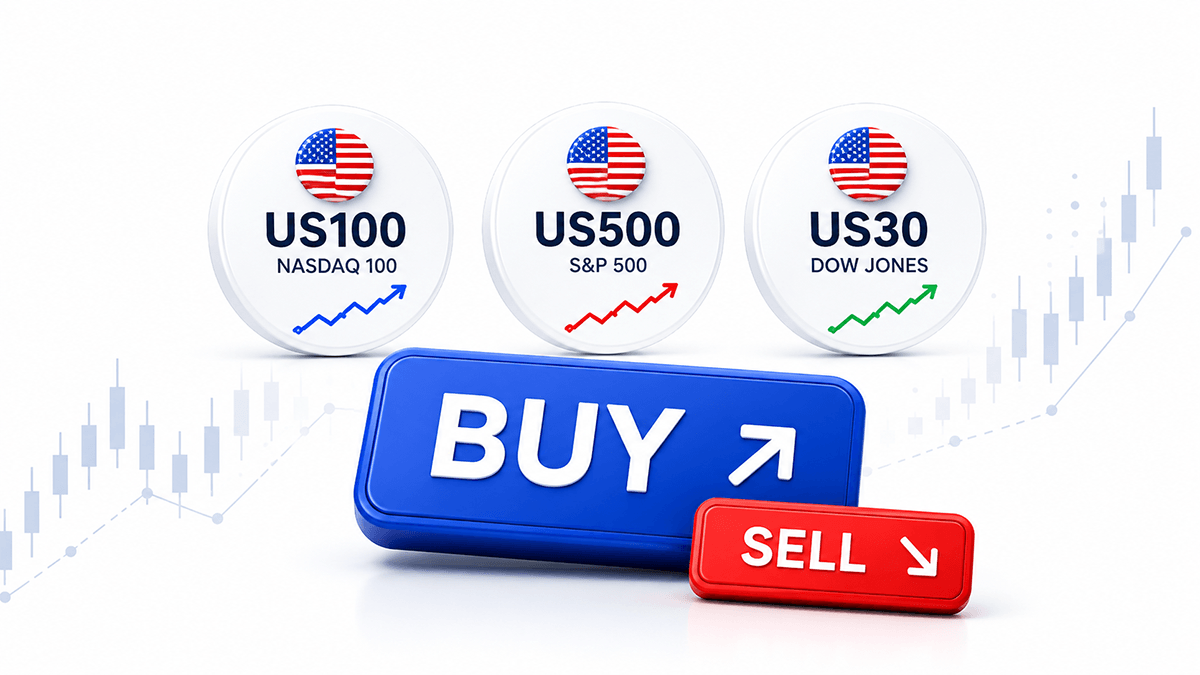
NAS100, US30 and US500 are popular trading symbols used by many CFD brokers to represent major US stock market indices.
These symbols are commonly linked to:
NAS100: Nasdaq 100
US30: Dow Jones Industrial Average
US500: S&P 500
Each index represents a different part of the US market. Understanding their differences can help beginners choose the right market for their trading style.
NAS100 Explained
NAS100 usually represents the Nasdaq 100 index. The Nasdaq 100 Index is widely known for its connection with innovation, technology and growth-focused companies.
NAS100 is popular among active traders because it can move quickly and often creates strong intraday trading opportunities. It is commonly influenced by technology stocks, earnings reports, interest rate expectations, inflation data and overall risk sentiment.
Why Traders Watch NAS100
Traders watch NAS100 because it is active, liquid and often volatile. It is especially popular among day traders, scalpers and swing traders who prefer fast-moving markets.
NAS100 may react sharply when large technology companies report earnings, when interest rate expectations change or when market sentiment shifts from risk-on to risk-off.
NAS100 Is Commonly Influenced By
Technology stock performance
Major earnings reports
Federal Reserve interest rate expectations
Inflation data
US dollar movement
Market risk sentiment
Global technology sector news
Because NAS100 can move quickly, beginners should avoid oversized positions and should always use proper risk management.
US30 Explained
US30 usually represents the Dow Jones Industrial Average. The Dow Jones Industrial Average tracks 30 major US blue-chip companies and is one of the most recognized stock market indices in the world.
US30 is often viewed as a benchmark for large, established US companies. It can be influenced by economic data, Federal Reserve decisions, blue-chip company earnings, industrial sector movement and global market sentiment.
Why Traders Watch US30
Traders watch US30 because it reflects the performance of major US blue-chip companies. It is widely followed during important economic events, market openings and earnings periods.
US30 can move strongly when economic data affects investor confidence, when Federal Reserve policy changes or when major companies release financial results.
US30 Is Commonly Influenced By
US economic data
Federal Reserve policy decisions
Blue-chip company earnings
Industrial and financial sector movement
Global market sentiment
Political and geopolitical news
US30 can be attractive for traders who prefer a major index with strong global recognition and active price movement.
US500 Explained
US500 usually represents the S&P 500 index. The S&P 500 Index tracks 500 leading US companies and is widely followed as a broad benchmark of the US stock market.
Compared with NAS100 and US30, US500 is generally more diversified because it includes companies from many sectors such as technology, healthcare, financials, energy, industrials, consumer goods and communication services.
Why Traders Watch US500
Traders watch US500 because it gives a broader view of US stock market performance. Many global investors, analysts and institutions use the S&P 500 as an important market benchmark.
US500 is useful for traders who want to follow the overall direction of the US equity market instead of focusing only on technology stocks or blue-chip companies.
US500 Is Commonly Influenced By
Broad US stock market sentiment
Inflation and interest rate expectations
Corporate earnings across multiple sectors
US economic data
Global investor risk appetite
Major geopolitical events
US500 is one of the most important indices for understanding the overall direction of the US stock market.
NAS100 vs US30 vs US500: Key Difference
Although NAS100, US30 and US500 are all connected to the US stock market, they are not the same.
NAS100
NAS100 is more focused on technology and growth companies. It can be more volatile and may move strongly when major technology stocks react to news.
US30
US30 represents 30 major blue-chip US companies. It is more focused on large, established businesses and is widely followed as a traditional market benchmark.
US500
US500 represents a broader group of 500 leading US companies. It is often used to understand the overall direction of the US stock market.
In simple words:
NAS100 = technology and growth market movement
US30 = major blue-chip company movement
US500 = broader US stock market movement
How Does Indices CFD Trading Work?
When traders trade index CFDs, they do not own the actual index or the companies inside it. Instead, they trade the price movement of the index.
If a trader believes an index may rise, they may open a buy position.
If a trader believes an index may fall, they may open a sell position.
This flexibility is one reason index CFDs are popular among active traders. However, CFD trading is often leveraged, and leverage can increase both potential profit and potential loss.
That is why beginners should focus on risk management before trying to increase profit.
What Moves NAS100, US30 and US500?
Indices move because of economic data, company earnings, central bank policy, investor sentiment and global news. Beginner traders should understand these drivers before trading.
1. Federal Reserve Interest Rate Decisions
US indices often react strongly to Federal Reserve interest rate decisions. If the market expects higher interest rates, indices may come under pressure because higher borrowing costs can reduce risk appetite. If the market expects lower rates, indices may rise as investor confidence improves.
2. Inflation Data
Inflation reports such as CPI and PPI can create strong volatility. Higher inflation may increase expectations of tighter monetary policy, while lower inflation may support risk assets.
3. US Jobs Data
Employment reports such as Non-Farm Payrolls and unemployment data can impact NAS100, US30 and US500. Strong jobs data can support economic confidence, but it can also influence interest rate expectations.
4. Corporate Earnings
Large company earnings can move indices, especially NAS100 and US500. Strong earnings may support an index, while weak earnings can create selling pressure.
5. Technology Sector Movement
Technology stocks have a major influence on NAS100. When large technology companies move sharply, NAS100 can become highly volatile.
6. Market Sentiment
Indices are highly sensitive to investor sentiment. During positive sentiment, traders may prefer risk assets. During uncertainty, investors may reduce exposure to equities.
7. Geopolitical Events
Political uncertainty, global conflicts, trade tensions and unexpected events can affect index prices. Traders should always stay updated before entering a position.
Before trading NAS100, US30 or US500, traders should check the Economic Calendar because major economic events can create strong volatility.
Best Time to Trade NAS100, US30 and US500
US indices are usually more active during the US trading session. The US market open often brings strong volatility because institutional traders, investors and market makers become active.
Common active periods include:
Before the US market opens
During the US market open
During major economic news releases
During the New York trading session
Near the US market close
Beginners should be careful during the first few minutes of the US market open because price can move quickly and spreads may widen during volatile periods.
How Beginners Can Start Trading Indices
Step 1: Understand the Index
Before trading NAS100, US30 or US500, learn what each index represents. Do not trade only because the chart is moving. Understand the market behind the symbol.
Step 2: Practice Before Trading Live
A demo account helps beginners learn platform tools, order placement, stop loss, take profit and position sizing without risking real capital.
Step 3: Learn the Trading Platform
Many traders use the MetaTrader 5 Trading Platform because it offers multiple timeframes, technical indicators, charting tools and order management features.
Step 4: Use Simple Technical Analysis
Beginners should start with simple tools such as trend direction, support and resistance, moving averages, price action and market structure.
For technical levels, traders can use the Pivot Point Tool to identify possible support and resistance areas.
Step 5: Calculate Risk Before Entry
Before opening a trade, traders should know their possible risk and reward. To estimate potential trading outcomes, traders can use the Profit Calculator.
Step 6: Follow Education First
Beginners should focus on learning before increasing trade size. For structured trading education, visit Zed Academy.
Basic Indices Trading Strategies for Beginners
1. Trend Trading
Trend trading means following the main direction of the market. If an index is making higher highs and higher lows, traders may look for buy opportunities. If an index is making lower highs and lower lows, traders may look for sell opportunities.
2. Support and Resistance Trading
Support is an area where price may find buying interest. Resistance is an area where price may face selling pressure. Traders often use these levels to plan entries, exits and stop loss placement.
3. Breakout Trading
A breakout happens when price moves above resistance or below support with momentum. Breakout trading can work well in indices, but false breakouts are common. Beginners should wait for confirmation before entering.
4. Pullback Trading
A pullback happens when price temporarily moves against the main trend. Traders may wait for price to return to a key level before entering in the direction of the trend.
5. News-Based Trading
Some traders trade around major economic news. However, news trading can be risky for beginners because price can move sharply in both directions. New traders should first observe how indices react to news before trading during such events.
Risk Management in Indices Trading
Risk management is the most important part of indices trading. A good trading strategy can fail if risk is not controlled.
Beginners should follow these rules:
Always use a stop loss
Do not risk too much on one trade
Avoid oversized lot sizes
Do not increase risk after a loss
Avoid revenge trading
Do not trade during major news without experience
Keep a written trading plan
Focus on consistency, not quick profit
Understand leverage before using it
Never trade with money you cannot afford to lose
Indices can move fast, especially during high-impact news. Proper risk management helps traders stay disciplined and avoid emotional decisions.
Common Mistakes Beginners Make in Index Trading
1. Trading Without Understanding the Index
Many beginners trade NAS100, US30 or US500 without knowing what they represent. Understanding the index helps traders make better decisions.
2. Using Too Much Leverage
Leverage can increase exposure, but it also increases risk. Beginners should use leverage carefully and start with smaller position sizes.
3. Ignoring Economic News
Indices can react strongly to economic reports. Ignoring the economic calendar can lead to unexpected losses.
4. Overtrading
Indices move throughout the day, but not every move is a trading opportunity. Quality setups are more important than many trades.
5. Moving Stop Loss Emotionally
Moving a stop loss without a valid reason can increase losses. A stop loss should be planned before entry.
6. Holding Losing Trades Too Long
Some traders hold losing positions hoping the market will reverse. This can be dangerous in fast-moving indices.
7. Trading Without a Plan
Every trade should have a clear reason, entry level, stop loss, take profit and risk amount.
Benefits of Trading Indices
Indices trading offers several advantages for global traders:
Access to broad market movement
One instrument represents a group of companies
Opportunities in rising and falling markets through CFDs
High trading activity during major market sessions
Useful for technical and fundamental analysis
Popular among day traders and swing traders
Can be used to express broader market views
For broader market access, traders can explore indices trading with Zed Capital.
Risks of Trading Indices
Indices trading also carries risk. Price can move quickly, especially during news events. Leverage can magnify losses. Market volatility, emotional trading, poor risk management, and lack of experience can all damage trading accounts.
Before trading indices, beginners should understand:
CFD trading involves risk
Leverage can increase losses
Market prices can move quickly
Stop loss is important
Demo practice is useful before live trading
Education and discipline are essential
Trading is not about taking every market move. It is about waiting for quality setups and managing risk properly.
How to Trade Indices on MT5
MetaTrader 5 is a popular platform for traders who want charting tools, technical indicators, multiple timeframes and order management features.
With MT5, traders can usually:
Analyze NAS100, US30 and US500 charts
Use technical indicators
Draw support and resistance levels
Place buy and sell orders
Set stop loss and take profit
Monitor open positions
Practice trading with a demo account
Trade through desktop, web, or mobile depending on broker availability
To explore platform features, visit the MetaTrader 5 Trading Platform page.
Why Global Traders Watch NAS100, US30 and US500
Global traders watch these three indices because they reflect major parts of the US stock market. Since the US market has strong influence on global finance, NAS100, US30 and US500 are followed by traders across many regions.
NAS100 is watched for technology and growth sentiment.
US30 is watched for blue-chip market strength.
US500 is watched for broader US market direction.
Together, these indices help traders understand the overall tone of the US equity market.
Zed Capital and Global Indices Trading
Zed Capital is a global forex and CFD broker offering access to multiple financial markets, including forex, metals, commodities, stocks, crypto, and indices. For traders interested in NAS100, US30 and US500, the key is to understand market movement, practice first, follow the economic calendar, and trade with proper risk management.
A professional trading approach is not based on guessing. It is based on education, discipline, structured analysis, and controlled risk.
Traders who also want to learn currency markets can explore the Forex Trading section.
Related Zed Capital Resources
External Authority References
To better understand the structure of major US indices, traders can review these official resources:
These references help traders understand how major US indices are structured and why they are widely followed by global market participants.
Final Thoughts
Indices trading can be a powerful way to follow major market movement. NAS100, US30 and US500 are among the most watched index symbols by global traders because they represent technology strength, blue-chip company performance and broad US stock market direction.
For beginners, the best approach is simple: learn the index, practice first, follow the economic calendar, use a stop loss and trade with a clear plan.
Successful trading is not about taking every market move. It is about waiting for quality setups, controlling risk and staying disciplined.
FAQs
What is indices trading?
Indices trading means trading the price movement of a stock market index such as NAS100, US30 or US500. Traders often access indices through CFDs without owning the underlying index or individual stocks.
What is NAS100?
NAS100 usually represents the Nasdaq 100 index. It is commonly associated with major Nasdaq-listed companies and is strongly influenced by technology and growth stocks.
What is US30?
US30 usually represents the Dow Jones Industrial Average. It tracks 30 major US blue-chip companies and is one of the most recognized stock market indices.
What is US500?
US500 usually represents the S&P 500 index. It tracks 500 leading US companies and is widely followed as a broad benchmark of the US stock market.
Is indices trading suitable for beginners?
Indices trading can be suitable for beginners if they first learn the basics, practice on a demo account and use strict risk management. However, indices can be volatile, so beginners should avoid high leverage and large lot sizes.
What moves NAS100, US30 and US500?
These indices are affected by interest rates, inflation data, jobs reports, company earnings, technology sector performance, market sentiment and geopolitical events.
Can I trade indices on MT5?
Yes, many brokers offer indices trading through MetaTrader 5. Traders can analyze charts, use indicators, place orders and manage risk through the platform.
Is indices trading risky?
Yes. Indices trading involves risk, especially when using leverage. Price can move quickly during news events, and losses can exceed expectations if risk is not managed properly.
Which is more volatile: NAS100, US30 or US500?
NAS100 is often more volatile because it is strongly influenced by technology and growth stocks. US30 and US500 can also move sharply, especially during economic news or major market events.
What is the best strategy for indices trading?
There is no single best strategy for everyone. Beginners can start with trend trading, support and resistance, pullback trading and breakout analysis. The most important part is risk management.
Start your trading journey with Zed Capital. Explore global markets, learn through Zed Academy, practice with discipline and trade with proper risk management.
Risk Disclaimer
Trading forex and CFDs involves significant risk and may not be suitable for all investors. Market prices can move quickly, especially when trading leveraged products. Always understand the risks before trading and never trade with money you cannot afford to lose.